
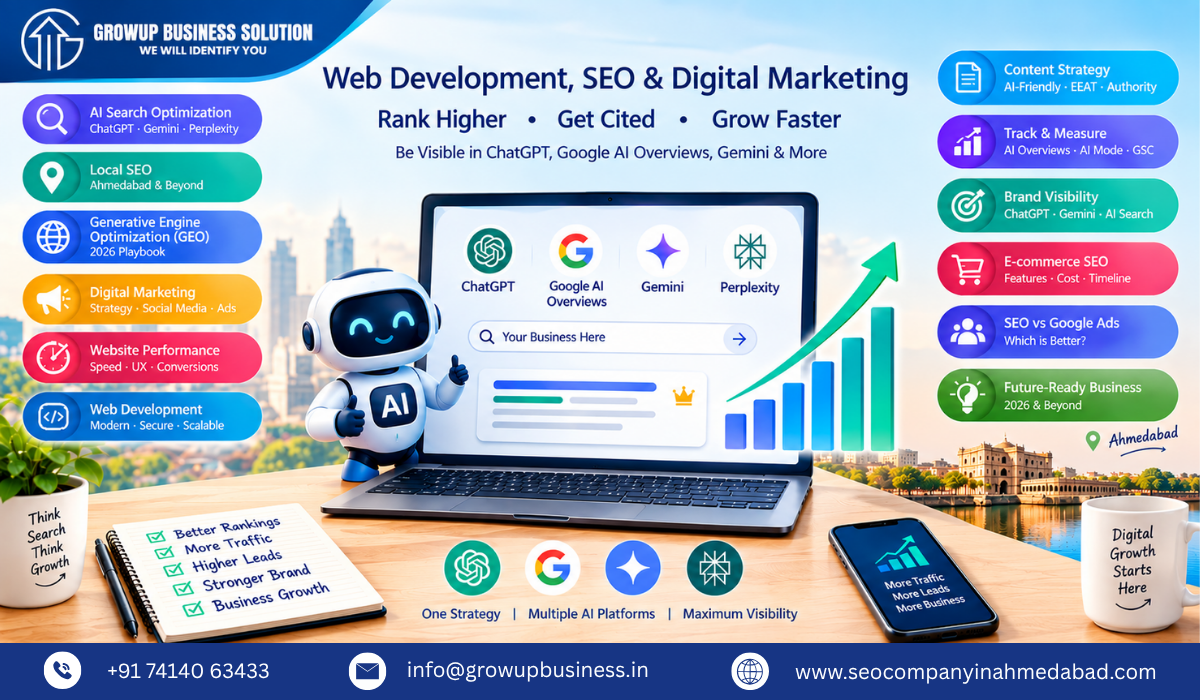
Why SEO Matters for AI Search?
Search is changing faster than ever. People are no longer relying only on traditional search engines to find information, compare services, or choose a company. They are increasingly asking AI-powered platforms such as ChatGPT, Google AI Overviews, Gemini, and other answer-focused search systems to provide direct recommendations and explanations. This shift makes SEO Matters for AI Search an important consideration for every modern business that wants long-term online visibility.
For businesses investing in digital marketing, the objective is no longer simply to rank a webpage for a keyword. Your content must be discoverable, understandable, trustworthy, technically accessible, and useful enough to be selected as a source by both conventional search engines and AI-powered systems.
What Is AI Search and Why Is SEO Still Important?
AI search combines information retrieval, natural-language understanding, and generative technologies to provide users with summarized answers. Instead of presenting only a list of blue links, AI systems may analyze multiple sources and generate a conversational response.
This is where AI Search SEO becomes important. Search engines and AI systems still need reliable web content to understand businesses, products, services, topics, locations, and expertise.
Google has specifically expanded its documentation around optimizing for generative AI features and states that established SEO fundamentals continue to matter for visibility in AI-powered search experiences.
Therefore, SEO for AI Search Engines is not a replacement for traditional SEO. It is an evolution of SEO that focuses on making content easier for both humans and machines to interpret.
How AI Search Optimization Works
Effective AI Search Optimization begins with strong fundamentals. Search engines and AI systems need to discover and interpret your website before they can potentially use its information.
A technically strong strategy should include:
- Crawlable website architecture
- Logical internal linking
- Search-friendly URLs
- Descriptive title tags and meta descriptions
- Clear H1, H2, and H3 heading structures
- Original and useful content
- Schema markup where appropriate
- Mobile-friendly design
- Fast page performance
- Secure HTTPS implementation
- Accurate business information
- Authoritative external references
- Strong topical relevance
Content should also answer questions directly. Instead of writing pages exclusively around repetitive keyword placement, businesses should create comprehensive resources that address the user's actual search intent.
For example, a page targeting “SEO services in Ahmedabad” can cover services, technical SEO, local SEO, content strategy, reporting, AI search optimization, frequently asked questions, and measurable business outcomes. This creates a stronger topical relationship than repeating the same keyword throughout a short article.
Generative Engine Optimization and Answer Engine Optimization
Two concepts receiving increasing attention are Generative Engine Optimization and Answer Engine Optimization.
Generative Engine Optimization focuses on improving the likelihood that information can be understood, retrieved, summarized, and potentially referenced by generative AI systems.
Answer Engine Optimization focuses on creating content that directly satisfies questions and conversational search intent.
Both approaches share important SEO foundations: useful information, strong topical coverage, clear structure, factual accuracy, authority, and technical accessibility.
The key difference is the presentation of information. Traditional SEO often focuses heavily on ranking individual pages, while AI-oriented optimization also considers whether your content contains concise, authoritative answers that can be incorporated into generated responses.
Why Structured, Trustworthy Content Matters
AI systems need context. A page that simply contains a collection of keywords provides little meaningful information. A well-structured page explains what a company does, who it serves, where it operates, what makes its services different, and why customers should trust it.
This makes expertise and credibility critical.
Businesses should demonstrate experience through detailed service pages, original insights, case studies, FAQs, author information where appropriate, supporting evidence, and consistent company information across the web.
For local businesses, location relevance is equally important. Mentioning genuine service areas, maintaining accurate business profiles, developing locally relevant content, and earning reputable local references can strengthen visibility across conventional and AI-powered discovery systems.
ChatGPT, Google AI Overviews, and Gemini SEO
Businesses should also understand that different AI platforms may use different systems and sources.
ChatGPT SEO Optimization should focus on making publicly available website content accessible, useful, well-structured, and technically crawlable. OpenAI states that websites should allow OAI-SearchBot to crawl their content to be eligible for inclusion in ChatGPT search, although placement cannot be guaranteed.
Similarly, Google AI Overviews SEO should build upon high-quality SEO fundamentals rather than treating AI search as an entirely separate marketing channel. Google's current documentation emphasizes that SEO best practices continue to be relevant for generative AI features.
A broader Gemini SEO Optimization strategy should likewise prioritize clear information architecture, useful content, entity understanding, structured data where relevant, and strong overall website quality.
The objective should not be to “hack” an AI model. Instead, businesses should make their information easier for search systems to discover, understand, evaluate, and connect with relevant queries.
Technical SEO for AI Search Visibility
Technical SEO remains one of the most important foundations for AI visibility. Even excellent content can struggle if search crawlers cannot access the website.
Businesses should regularly check robots.txt, XML sitemaps, canonical tags, indexability, HTTP status codes, JavaScript rendering, page speed, mobile usability, internal links, redirects, and duplicate content.
For websites seeking visibility in ChatGPT search, crawler accessibility deserves particular attention. OpenAI recommends allowing OAI-SearchBot and ensuring that hosting or CDN infrastructure does not block its published crawler traffic.
Structured data can also help search systems understand entities and page relationships, although markup should accurately represent visible page content and should never be treated as a guarantee of enhanced visibility.
The Future of SEO Is Search Everywhere
The biggest reason SEO Matters for AI Search is simple: customers are changing how they discover information.
A potential customer might search Google traditionally, ask an AI assistant for recommendations, compare businesses through an AI-generated summary, and finally visit a company's website before making a decision.
That means businesses need an integrated strategy covering technical SEO, content marketing, local SEO, authority building, user experience, and AI-focused search optimization.
Growup Business Solution can help businesses build this foundation through strategic SEO, high-quality content, technical optimization, local search strategies, and AI-ready website structures.
The future belongs to businesses that do more than chase rankings. They create genuinely useful information, establish topical authority, maintain technically accessible websites, and consistently demonstrate why their brand deserves to be discovered.
Ultimately, SEO Matters for AI Search because AI search still depends on the open web for relevant information. Businesses that invest today in technically sound, authoritative, people-first SEO can build stronger visibility across both traditional search results and the rapidly evolving AI search ecosystem.