
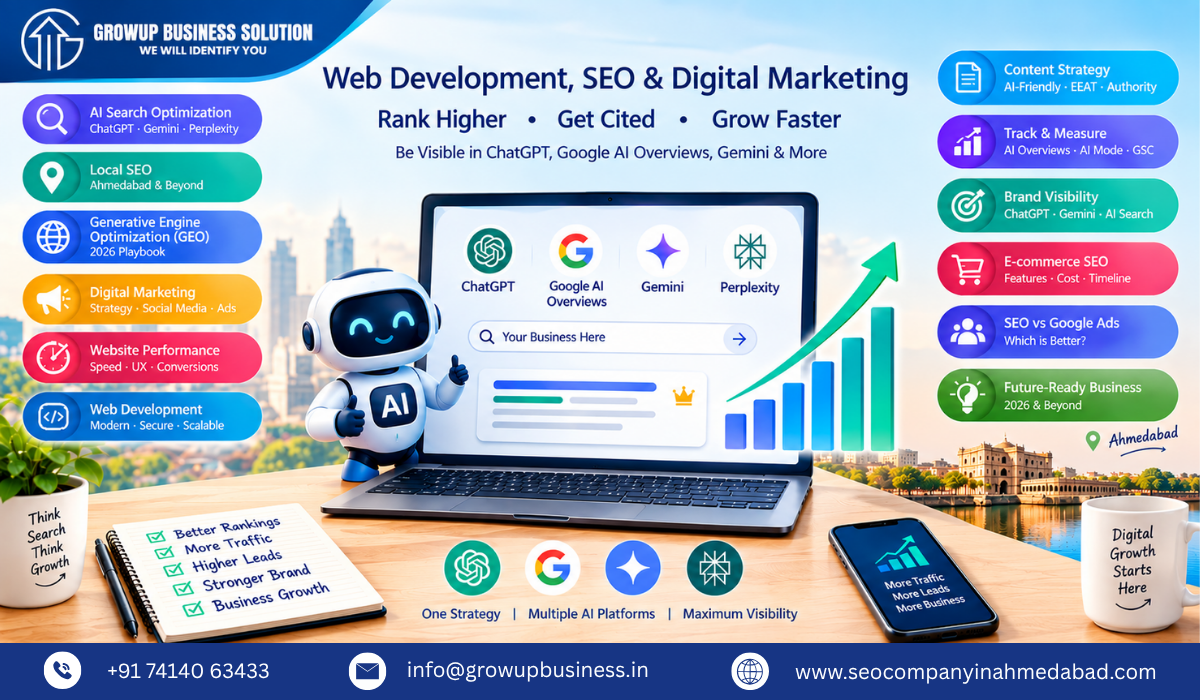
How to Optimize Your Website for ChatGPT, Gemini, and Google AI Search
Search is entering a new phase. Users are no longer depending only on traditional blue-link results. They increasingly ask AI systems for recommendations, comparisons, explanations, product information, and business solutions. This makes optimization for Gemini, and Google AI Search an important part of a modern digital marketing strategy.
For businesses, the goal is not to manipulate AI systems into mentioning a website. Instead, the objective is to build a technically accessible, trustworthy, well-structured, and genuinely useful website that search engines and AI systems can understand.
Google's current guidance confirms that established SEO fundamentals continue to matter for generative AI search features. It also emphasizes unique, helpful content rather than content created simply to influence rankings.
Why AI Search Optimization Matters
Traditional SEO focuses heavily on rankings, clicks, keywords, links, and organic traffic. AI search adds another layer: whether your information can be understood, selected, summarized, and potentially cited within an AI-generated answer.
This is where ChatGPT SEO Optimization becomes relevant. A website should provide clear information about its business, services, products, expertise, locations, and customer problems. Pages that communicate information clearly are easier for modern search systems to interpret.
The same principle applies to Gemini SEO Optimization. Rather than creating a separate page for every possible AI query, businesses should develop authoritative content that comprehensively covers topics and answers related questions.
1. Build a Strong Technical SEO Foundation
Before focusing on AI visibility, make sure search crawlers can properly access and understand your website.
Your technical SEO checklist should include:
- Crawlable and indexable pages
- Clean URL structures
- Logical website architecture
- XML sitemap
- Correct robots.txt configuration
- Canonical URLs
- Mobile-friendly design
- HTTPS security
- Fast-loading pages
- Strong Core Web Vitals
- Proper internal linking
- Descriptive title tags and meta descriptions
- Structured data where appropriate
Canonicalization is particularly important for websites with similar URLs, filters, regional pages, or duplicate content. Google explains that canonicalization helps identify the representative URL among duplicate or substantially similar pages.
A technically weak website cannot compensate for excellent content simply by adding AI-related keywords.
2. Create Content That Answers Real Questions
Effective Google AI Search Optimization starts with understanding what your audience actually wants to know.
Instead of writing an article around one keyword repeatedly, build content around a complete topic. For example, an accounting firm could create a detailed resource covering GST registration, eligibility, required documents, costs, timelines, common mistakes, and compliance requirements.
This approach helps establish topical depth.
Your content should answer:
- What is the problem?
- Why does it matter?
- What are the available solutions?
- How does the process work?
- What does it cost?
- Who needs it?
- What mistakes should users avoid?
- What makes your business different?
Google specifically recommends creating unique and valuable content based on first-hand experience and information that provides something beyond easily available generic material.
3. Use AI Content Optimization Carefully
AI Content Optimization does not mean publishing hundreds of automatically generated articles. AI tools can assist with research, topic clustering, content briefs, competitor analysis, and editing, but human expertise should control the final information.
Google's spam policies specifically identify scaled content abuse when large quantities of unoriginal pages are produced primarily to manipulate search rankings. This applies regardless of whether automation or generative AI was used.
For better results, add original elements such as:
- Industry-specific examples
- Expert opinions
- Original statistics
- Case studies
- Product specifications
- Practical processes
- FAQs based on customer questions
- Local market insights
- Author expertise and credentials
The result should be useful even if the reader never discovers how the page was created.
4. Structure Information for Humans and AI
A well-organized page supports both traditional search and AI interpretation.
Use one clear H1, logical H2 and H3 sections, short paragraphs, descriptive headings, bullet lists, tables, definitions, and direct answers.
For example, instead of writing a large paragraph about a service, use a structure such as:
What is the service?
Explain the concept in simple language.
How does it work?
Describe the process step by step.
Who needs it?
Identify relevant users or industries.
What does it cost?
Explain pricing factors without making unsupported promises.
Why choose your company?
Provide evidence, experience, capabilities, and differentiators.
This structure improves readability while making important information easier to identify.
5. Optimize for AI Search Without Keyword Stuffing
AI Search Optimization should focus on meaning, context, entities, and relationships—not repetitive keyword insertion.
For example, a page targeting “industrial air compressor supplier” should naturally discuss compressor types, applications, specifications, industries, maintenance, installation, service support, and purchasing considerations.
Semantic relevance allows a page to cover related concepts naturally.
This is especially important for SEO for AI Search Engines, because conversational systems may interpret a user's question differently from the exact wording used on your webpage.
A user might search:
“Which compressor is suitable for a manufacturing plant?”
Your website does not necessarily need that exact sentence everywhere. A detailed page explaining compressor selection for manufacturing applications can address the underlying intent.
6. Strengthen Your Brand and Entity Signals
AI systems need reliable context about businesses. Make your company information consistent across your website and important external platforms.
Clearly communicate:
- Company name
- Products and services
- Locations served
- Industry expertise
- Contact information
- Experience
- Certifications
- Business history
- Authors and experts
- Customer reviews where appropriate
Consistent information can help establish what your business is, what it does, and where it operates.
For local companies, this becomes especially important because location, service area, and business category can influence how users discover relevant providers.
7. Implement AI Citation Optimization
AI Citation Optimization focuses on increasing the likelihood that useful, authoritative information from your website can become a source considered by AI-powered search experiences.
There is no legitimate technique that guarantees an AI system will cite a specific webpage. Instead, focus on making your information genuinely reference-worthy.
Strong citation-oriented content should contain clear claims, supporting evidence, original information, precise explanations, and identifiable expertise.
Build topic clusters where supporting articles connect to comprehensive service or category pages through logical internal links.
8. Combine GEO and AEO With Traditional SEO
Generative Engine Optimization and Answer Engine Optimization are increasingly discussed in modern search strategies. However, they should complement—not replace—fundamental SEO.
Google's current documentation explicitly explains that optimization for generative AI search experiences still relies on established SEO practices. It also warns against focusing on supposed “AEO/GEO hacks” instead of creating useful content and maintaining strong technical foundations.
For businesses, the practical strategy is simple:
Technical SEO + Helpful Content + Entity Signals + Structured Information + Authority + Continuous Measurement
That combination creates a stronger foundation for both conventional and AI-powered discovery.
9. Make Your Website AI-Friendly
AI-Friendly Website Optimization should ensure that important business information is easy to crawl, interpret, and connect.
Review your website for:
- JavaScript-rendered critical content
- Blocked resources
- Incorrect noindex directives
- Poor internal linking
- Duplicate pages
- Missing structured data
- Unclear page hierarchy
- Thin location pages
- Outdated information
- Weak author and business signals
Google's latest documentation continues to emphasize technical accessibility and quality as key considerations for appearing in generative AI search experiences.
Final Thoughts
Optimizing a website for Gemini, and Google AI Search is not about finding a secret AI ranking formula. It is about making your website the clearest, most useful, technically accessible, and trustworthy source for the topics your customers search for.
A sustainable strategy combines ChatGPT SEO Optimization, Gemini SEO Optimization, Google AI Search Optimization, AI Search Optimization, Generative Engine Optimization, and Answer Engine Optimization with proven technical SEO practices.
Businesses should also remember that AI search visibility cannot be guaranteed. Search systems continuously evolve, and AI-generated answers may vary by query, user, location, language, and context.
The strongest long-term approach is therefore to build a website that deserves to be found, understood, referenced, and trusted—whether the user reaches it through a traditional search result or an AI-generated answer.